
Trilogie Bioscience offers an expanding portfolio of well-characterized and emerging E3 ligase reagents to support ubiquitin biology, targeted protein degradation, mechanistic enzymology, and drug discovery research. These E3 ligases provide researchers with critical tools for studying protein ubiquitination, substrate recognition, signaling regulation, and proteostasis pathways.
E3 ligases function as the precision controllers of protein fate within the ubiquitin proteasome system. By selecting and tagging proteins for degradation or signaling, E3 ligases determine substrate specificity and regulate essential cellular processes including cell cycle progression, DNA repair, immunity, and protein homeostasis. Dysregulation of E3 ligases has been implicated in cancer, neurodegeneration, and other diseases, making them highly valuable therapeutic targets and central components of targeted protein degradation strategies.
E3 ubiquitin ligases are the substrate recognition and specificity determinants of the ubiquitin system. These enzymes select target proteins for ubiquitination and coordinate transfer of ubiquitin from E2 conjugating enzymes to substrate proteins.
E3 ligases are central regulators in diseases including cancer and neurodegeneration. Their ability to selectively control protein fate has made them key targets for modern targeted protein degradation approaches such as PROTACs and molecular glues.
E3 ligases are broadly categorized into several mechanistic families, including RING, HECT, and RBR ligases. Each family utilizes distinct structural and catalytic mechanisms to mediate ubiquitin transfer while contributing to the diversity and specificity of ubiquitin signaling pathways.
RING ligases facilitate direct transfer of ubiquitin from E2 enzymes to substrate proteins and represent the largest class of E3 ligases.
HECT ligases form catalytic ubiquitin intermediates prior to substrate transfer, enabling additional layers of ubiquitin regulation and chain specificity.
RBR ligases combine mechanistic features of both RING and HECT ligases and play important roles in signaling and disease-associated pathways.
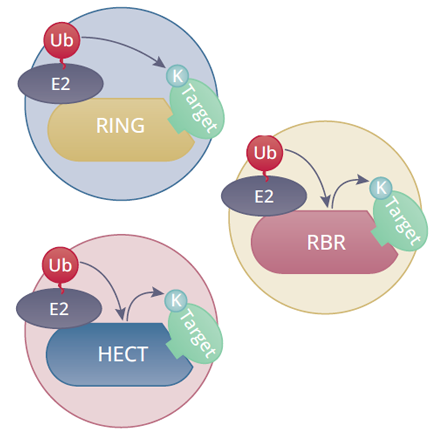
Representative architectures of major E3 ligase families including RING, HECT, and RBR E3 ligases, each utilizing distinct mechanisms for ubiquitin transfer and substrate regulation.
Trilogie’s E3 ligase portfolio provides researchers with purified, functionally active reagents for studying ubiquitin-mediated degradation, substrate specificity, signaling pathways, and therapeutic protein degradation systems.
Recent studies estimate that the human proteome contains approximately 672 E3 ligases spanning multiple mechanistic families and Cullin-RING ligase systems. This diversity enables highly selective regulation of protein fate across nearly all major cellular pathways.
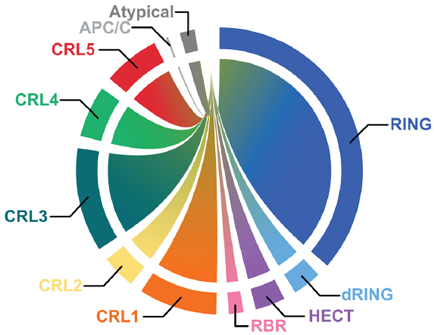
Distribution of major E3 ligase families in human biology, highlighting the diversity of ubiquitin ligase architectures and substrate recognition systems. Current estimates place the number of human E3 ligases at approximately 672. Credit: N.K. Chua and R. Feltham, WEHI Institute.
| Product | Product Code | Price | Details |
|---|---|---|---|
| CRBN / DDB1 | TE3-015 | From $350.00 | Show details |
| NleL | TE3-020 | From $350.00 | Show details |
| VHL / EloB / EloC | TE3-019 | From $350.00 | Show details |
| FBXO22 / SKP1 | TE3-028 | From $350.00 | Show details |
| CRBN / DDB1(ΔB) | TE3-085 | From $350.00 | Show details |
| UBE3C | TE3-066 | From $350.00 | Show details |
| AREL1 (436-823) | TE3-065 | From $350.00 | Show details |
| KLHDC2 (1-360) | TE3-086 | From $350.00 | Show details |
| CUL1 / RBX1, Neddylated | TE3-029 | From $350.00 | Show details |
| DCAF16 / DDB1 / DDA1 | TE3-112 | From $350.00 | Show details |
| CUL3 / RBX1, Neddylated | TE3-034 | From $350.00 | Show details |
| DCAF11 / DDB1 / DDA1 | TE3-099 | From $350.00 | Show details |
| FBXO31 / SKP1 | TE3-091 | From $350.00 | Show details |
| CHIP | TE3-116 | From $350.00 | Show details |
| SPOP | TE3-111 | From $350.00 | Show details |
| CUL2 / RBX1, Neddylated | TE3-018 | From $525.00 | Show details |
| Parkin | TE3-033 | From $350.00 | Show details |
| E6AP (UBE3A) | TE3-130 | From $350.00 | Show details |
| FBXO42 / SKP1 | TE3-127 | From $350.00 | Show details |
| KLHDC2 / EloB / EloC | TE3-137 | From $350.00 | Show details |
| FBXO3 / SKP1 | TE3-138 | From $350.00 | Show details |
| CUL4A / RBX1, Neddylated | TE3-014 | From $525.00 | Show details |
| ARIH1 | TE3-136 | From $350.00 | Show details |
Don’t see the E3 ligase you need?
Study ubiquitin-mediated degradation pathways, substrate recruitment, and selective protein turnover using functionally active E3 ligases.
Support degrader screening and induced proximity research with biologically relevant ubiquitin ligase systems.
Investigate ubiquitylation pathways, enzyme specificity, substrate recognition, and signaling regulation.
Enable reproducible biochemical assays for therapeutic discovery programs targeting ubiquitin system pathways.
Examine E3 ligase involvement in cell cycle regulation, DNA repair, stress response pathways, and protein homeostasis.
E3 ligases are enzymes within the ubiquitin proteasome system that select substrate proteins for ubiquitylation and regulate protein degradation and signaling pathways.
Major E3 ligase families include RING, HECT, and RBR ligases, each utilizing distinct catalytic mechanisms for ubiquitin transfer.
E3 ligases are central to targeted protein degradation technologies including PROTACs and molecular glues, making them highly valuable therapeutic targets and screening tools.
Applications include ubiquitin biology research, targeted protein degradation studies, mechanistic assays, degrader discovery, and therapeutic screening workflows.
No. These products are for research use only and are not approved for diagnostic or therapeutic use.