How DNA-Encoded Libraries Are Expanding the TPD Toolbox

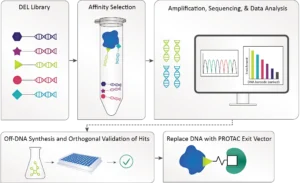
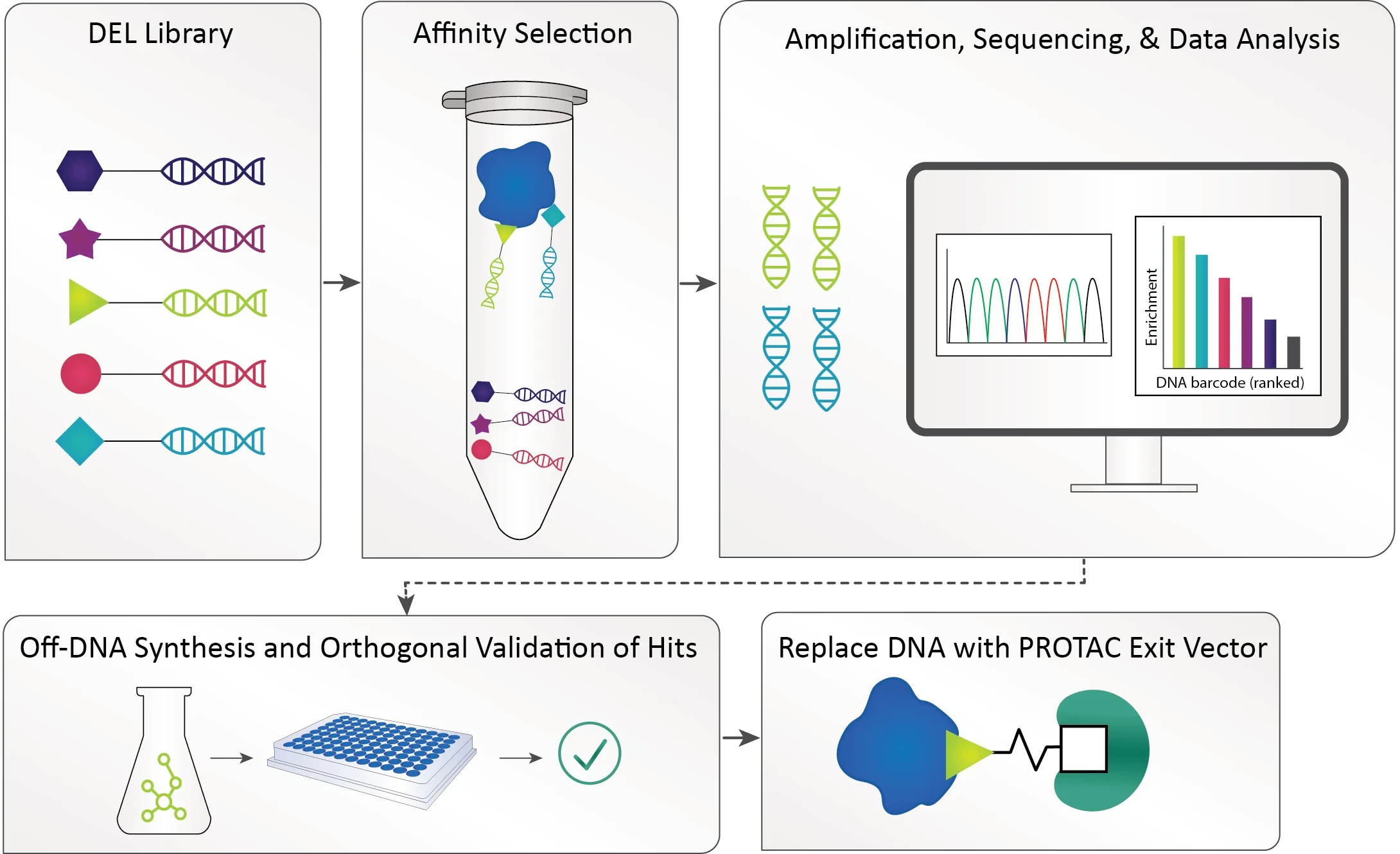
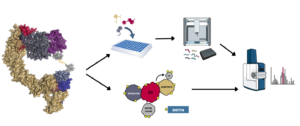
Figure 1. DNA-encoded library (DEL) screening workflow for ligand discovery and degrader development.

Over the past several years, the targeted protein degradation (TPD) field has witnessed a steady expansion in the number of reported ligands for E3 ligases and UPS-associated proteins. This progress reflects both the emergence of new discovery technologies and the application of established screening approaches with induced proximity in mind.

DNA-encoded libraries (DELs) are one example of a new discovery technology that is uniquely suited for degrader molecule discovery. DEL platforms consist of small molecules linked to unique DNA barcodes, allowing affinity-selected binders to be identified through amplification and sequencing of their DNA tags. This strategy enables screening of exceptionally large and diverse libraries, approaching the scale traditionally associated with phage and mRNA display technologies. Because DEL selections rely on direct molecular recognition rather than functional activity, high-quality proteins with native folding and activity are critical for generating meaningful hits. Importantly for degrader discovery, the DNA attachment point often provides a chemically tractable exit vector that can be leveraged during hit optimization and replaced with a linker for the construction of heterobifunctional degraders (Wen 2025).

Two recent studies highlight the impact of this approach. Reddy Guduru et al. (2025) used DEL screening against DDB1 to identify a previously uncharacterized ligand-binding site and subsequently optimized screening hits into structurally validated ligands.  Likewise, Lucas et al. (2025) reported the discovery of novel CHIP (STUB1) ligands through DEL screening, with medicinal chemistry optimization establishing a promising starting point for future degrader development. Whether these ligands ultimately prove effective as degrader components remains to be seen, but they represent important additions to the growing repertoire of UPS-directed chemical matter.

Importantly, the impact of DELs in TPD extends beyond E3 ligase discovery. One longstanding promise of TPD is the ability to leverage non-inhibitory ligands to target proteins of interest that would have little value in traditional drug discovery campaigns. A recent perspective highlights the potential of allosteric and functionally silent binders as degradation warheads (Frost 2026), and affinity-based screening approaches such as DELs may be particularly well suited to uncovering such ligands. As technologies for ligand discovery continue to evolve, researchers are gaining access to both new recruiters and new target-binding chemotypes that promise to broaden the reach of induced proximity therapeutics.

Q&A

What makes a protein suitable for DEL screening?

High-quality DEL screening should start with a protein that is correctly folded, functionally active, and biochemically stable throughout the selection process. Affinity tags should minimize nonspecific interactions, with His and biotin tags generally preferred over larger tags that can increase background binding. Whenever possible, assay performance should be validated using known ligands or inhibitors to confirm target integrity and enable competitive selections that enrich binders to the desired binding pocket. 

No. While DEL can identify binders, successful PROTAC ligands must also promote formation of a productive ternary complex between the target protein and an E3 ligase. Factors such as binding orientation, ternary complex cooperativity, physicochemical properties, and cellular permeability often require significant optimization before a DEL hit can become an effective degrader. 

DEL hits require orthogonal validation to confirm binding and eliminate false positives. Follow-up studies typically include resynthesis of the compound, affinity measurements (such as SPR, BLI, or ITC), functional assays, structural characterization when possible, and, for PROTAC programs, incorporation into bifunctional molecules and evaluation of ternary complex formation and cellular target degradation.

References

Wen, L., Zhang, Q., Duan, Z., Jin, R., & Lu, X. (2026). DNA‐Encoded Libraries for the Discovery of E3 Ligase Ligands. ChemMedChem, 21(8), e202501032. 

Reddy Guduru, S. K., Caldwell, J. P., Digianantonio, K. M., Prophet, S. M., Yang, S., Gareiss, P., … & Békés, M. (2026). DNA-Encoded Library (DEL) Selection Identifies a Distinct DDB1 Ligand Binding Site. ACS Medicinal Chemistry Letters, 17(4), 757-767. 

Lucas, S. C., Milbradt, A. G., Breed, J., De Genst, E., Jackson, A., Solovyeva, A., … & Phillips, C. (2025). Discovery of Small-Molecule Ligands for the E3 Ligase STUB1/CHIP from a DNA-Encoded Library Screen. ACS Medicinal Chemistry Letters, 16(8), 1445-1451. 

Frost, A., O’Connor, S., & Ciulli, A. (2026). Allosteric PROTACs: Expanding the Horizon of Targeted Protein Degradation. Journal of the American Chemical Society.

Additional Resources

In Vitro Proximity and Ubiquitylation Assays

In Vitro Proximity Assays in Drug Discovery

In Vitro Proximity and Ubiquitylation Assays for CRBN, VHL and Emerging Ligases of Interest in TPD Introduction Trilogy offers top-quality products and custom services. Our innovative in vitro assays complement cell-based methods, providing valuable insights in TPD workflows. We feature HTS-compatible reagents and assays for screening and mechanistic studies, including

Read More »