
Trilogie Bioscience’s DCAF ligase reagents enable targeted investigation of CRL4-mediated ubiquitination, substrate recognition, and selective protein degradation pathways. These purified, pre-assembled human protein complexes support biochemical assays, mechanistic studies, and next-generation targeted protein degradation research workflows.
DCAFs (DDB1- and CUL4-associated factors) function as substrate receptors within the CRL4 E3 ubiquitin ligase complex, recruiting specific proteins for ubiquitylation and proteasomal degradation. Through this selective substrate recognition, DCAF-containing ligase complexes regulate key biological processes including DNA repair, cell cycle progression, transcription, and protein homeostasis.
DCAFs serve as substrate receptors for CRL4 E3 ubiquitin ligase complexes, enabling selective recruitment of target proteins for ubiquitylation and degradation through the ubiquitin proteasome system. Their modular architecture supports precise regulation of cellular signaling and protein turnover pathways.
DCAF ligases have emerged as important tools for targeted protein degradation and molecular glue development because of their ability to mediate highly selective substrate recruitment and induced proximity interactions.
Reference:
Cheng, J., Bin, X., Tang, Z. Cullin-RING Ligase 4 in Cancer: Structure, Functions, and Mechanisms. Biochimica et Biophysica Acta. 2024 Sept;1879(5):189169, doi: 10.1016/j.bbcan.2024.189169. PMID: 39117093.
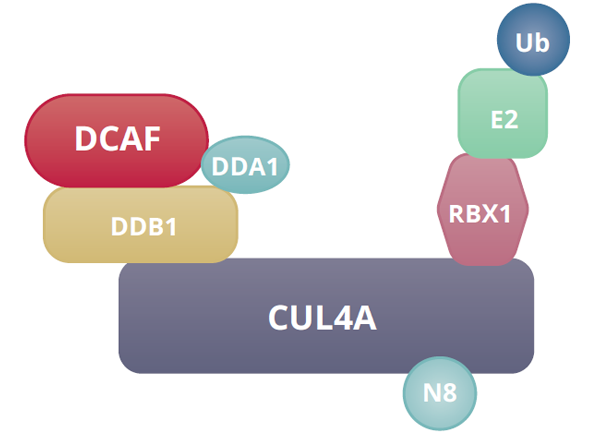
Schematic representation of the SCF (SKP1–Cullin–F-box) E3 ligase complex highlighting the substrate recognition role of F-box proteins within ubiquitin-mediated degradation pathways.
Trilogie’s DCAF ligase products are designed to support reproducible biochemical assays and mechanistic studies through the use of purified, pre-assembled, and functionally active human protein complexes.
Trilogie offers functionally active DCAF11 / DDB1 / DDA1 and DCAF16 / DDB1 / DDA1 complexes for investigating substrate recruitment, ternary complex formation, induced proximity biology, and CRL4-mediated degradation pathways.
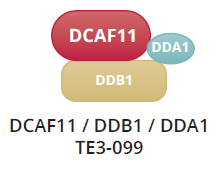
The DCAF11 complex supports studies of ubiquitin-mediated degradation, substrate recognition, and degrader-induced protein interactions.
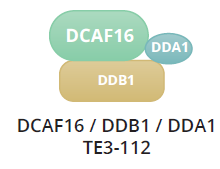
The DCAF16 complex enables mechanistic investigation of molecular glue biology, induced proximity systems, and CRL4-dependent degradation pathways.
The hook effect analysis shown above demonstrates functional assembly and biological activity of the DCAF16 / DDB1 / DDA1 complex using the KB02-JQ1 degrader and BRD4 substrate system. Signal intensity increases across degrader concentrations until reaching a maximum near 1 μM before declining at higher concentrations, consistent with ternary complex hook effect behavior commonly observed in induced proximity systems.
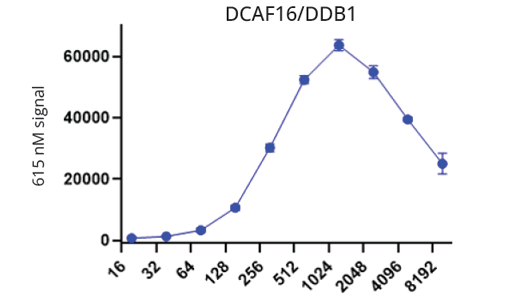
Increasing 615 nm signal is observed across increasing concentrations of KB02-JQ1 reaching a maximum at ~1 μM. Higher concentrations result in a signal decline, consistent with a hook effect.
Zhang, X. et al. (2019) Nat Chem Biol. 15(7):737–746
| Product | Product Code | Price | Details |
|---|---|---|---|
| DCAF16 / DDB1 / DDA1 | TE3-112 | From $350.00 | Show details |
| DCAF11 / DDB1 / DDA1 | TE3-099 | From $350.00 | Show details |
Need additional assay components or customized degradation workflow support?
Study substrate recruitment, CRL4-mediated ubiquitination, and induced degradation pathways using functionally active DCAF ligase complexes.
Evaluate degrader-mediated ternary complex formation and selective protein interactions in molecular glue development workflows.
Support biochemical characterization of targeted protein degradation systems and induced proximity biology.
Investigate DCAF-regulated pathways involved in DNA repair, transcriptional regulation, and cell cycle progression.
Enable reproducible biochemical assays for therapeutic discovery programs targeting ubiquitin-mediated degradation pathways.
DCAFs (DDB1- and CUL4-associated factors) are substrate receptor proteins within CRL4 E3 ubiquitin ligase complexes that recruit target proteins for ubiquitylation and proteasomal degradation.
CRL4 complexes are Cullin-RING E3 ubiquitin ligase assemblies containing CUL4A, DDB1, RBX1, DDA1, and a DCAF substrate receptor protein.
DDA1 is included to enhance complex stability and support proper assembly of functional CRL4DCAF protein complexes.
Applications include targeted protein degradation research, molecular glue discovery, degrader screening, CRL4 mechanistic assays, and ubiquitin pathway studies.
No. These products are for research use only and are not approved for diagnostic or therapeutic use.