
Trilogie Bioscience offers neddylated Cullin/RBX1 complexes to support research into ubiquitin transfer, substrate recognition, and Cullin-RING E3 ligase (CRL) activity. These research-use-only reagents provide core scaffold components for assembling CRL-based biochemical systems and investigating ubiquitin-dependent protein regulation.
Cullin-RING ligases are a major class of E3 ubiquitin ligases. CRL1–5 collectively comprise more than 300 substrate receptor-defined E3 ligases. Distinct Cullin scaffolds recruit different adaptor and substrate-recognition proteins, allowing researchers to study a broad range of cellular targets and ubiquitylation mechanisms.
Cullins provide the central scaffold of CRL complexes, bringing substrate-recognition modules into proximity with the ubiquitin-transfer machinery. Specific adaptor and receptor combinations determine which substrates a complex can recognize. Neddylation, the covalent addition of NEDD8, promotes CRL activation and efficient ubiquitin transfer.
CRL1 complexes are built around CUL1 and RBX1, with SKP1 linking the scaffold to an F-box substrate receptor. The substrate receptor helps determine which proteins are recruited for ubiquitylation.
CRL2 uses a CUL2/RBX1 scaffold with Elongin B and Elongin C adaptor proteins. The VHL-containing complex shown illustrates one substrate-recognition configuration.
CRL3 complexes use CUL3/RBX1 with BTB-domain substrate-recognition proteins. The BTB dimer arrangement is shown and provides a CRL3–SPOP biochemical example.
CRL4A combines a CUL4A/RBX1 scaffold with DDB1 and a DCAF substrate receptor, supporting substrate recruitment within this CRL architecture.
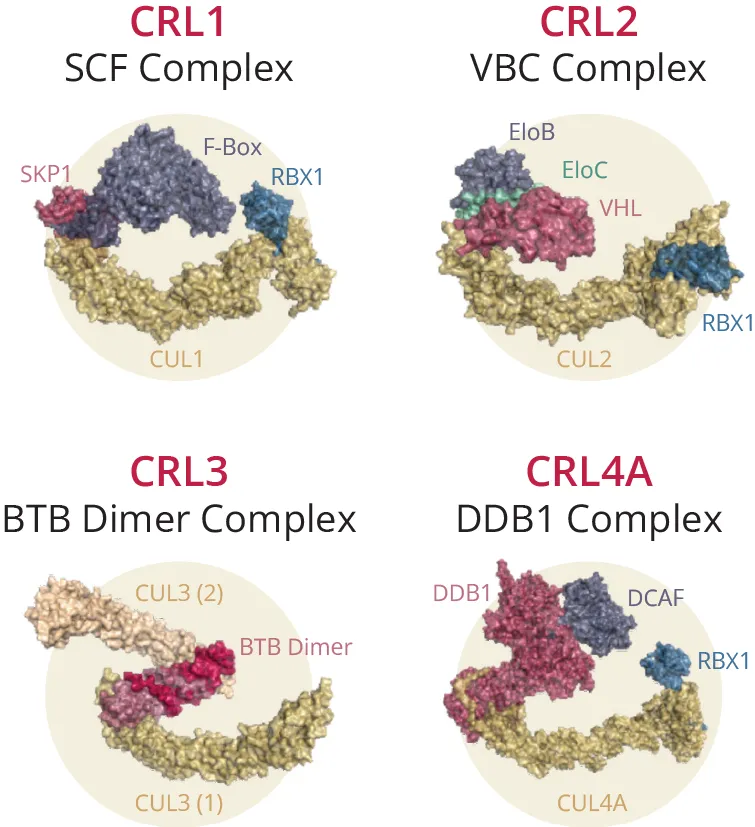
Representative CRL1 (SCF), CRL2 (VBC), CRL3 (BTB dimer), and CRL4A (DDB1) complex architectures.
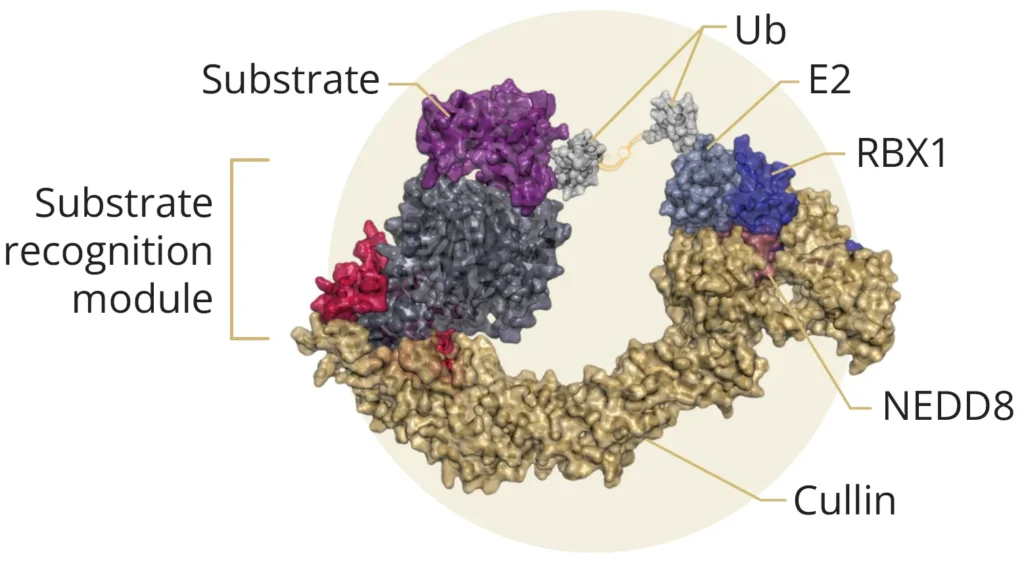
Generic architecture of an active CRL showing the substrate-recognition module, Cullin, RBX1, NEDD8, E2, ubiquitin, and substrate.
An active CRL brings together a substrate-recognition module, a Cullin scaffold, RBX1, and the ubiquitin-charged E2 enzyme. NEDD8 modification of the Cullin supports the active configuration of the complex and promotes ubiquitin transfer to recruited substrates.
Protein ubiquitylation occurs through a coordinated enzymatic cascade involving E1 ubiquitin-activating enzymes, E2 ubiquitin-conjugating enzymes, and E3 ubiquitin ligases. E1 enzymes activate ubiquitin in an ATP-dependent reaction and transfer it to an E2 enzyme. Cullin-RING E3 ligases function at the final stage of this cascade, bringing ubiquitin-loaded E2 enzymes into proximity with recruited substrates to promote ubiquitylation. Repeated ubiquitin transfer can generate polyubiquitin chains that regulate protein stability, degradation, and cellular signaling.
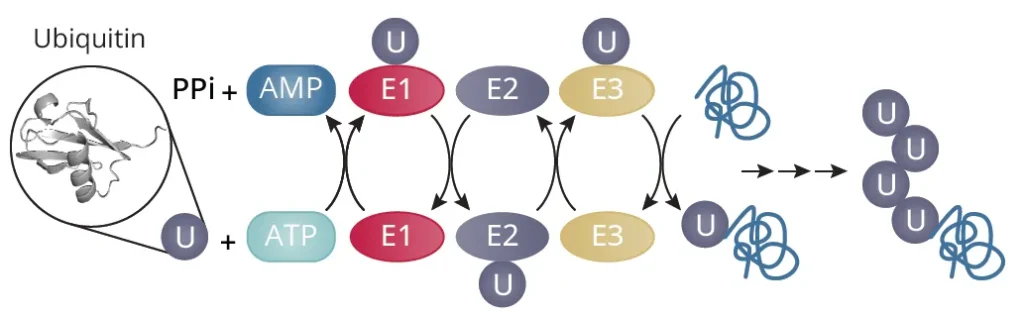
Schematic representation of the E1–E2–E3 ubiquitin cascade, illustrating ATP-dependent ubiquitin activation by an E1 enzyme, transfer to an E2 conjugating enzyme, and E3-mediated substrate ubiquitylation and polyubiquitin chain formation.
Trilogie supplies neddylated CUL1/RBX1, CUL2/RBX1, CUL3/RBX1, and CUL4A/RBX1 reagents, enabling researchers to select the appropriate core scaffold for different CRL systems. Companion components are available for constructing in vitro ubiquitylation workflows.
An in vitro reaction demonstrating native recognition and polyubiquitylation of BRD4 by CRL3–SPOP. Each reaction contained SPOP, neddylated CUL3/RBX1, UBE2D1 (E2), UBA1 (E1), BRD4-BD1+BD2, and ubiquitin. Reactions were run at 37°C for 60 minutes and visualized by Coomassie staining.
The gel illustrates time-dependent formation of higher molecular weight polyubiquitin species, as well as discrete ubiquitylation species (mono-ubiquityled, di-ubiquitylated, etc.) CUL3 and BRD4. Depletion of mono-ubiquitin also verifies the generation of polyubiquitin-conjugated species. This experiment provides a practical example of using Trilogie reagents in a reconstituted CRL3 ubiquitylation workflow. It should not be interpreted as validation data for the other three Cullin complexes.
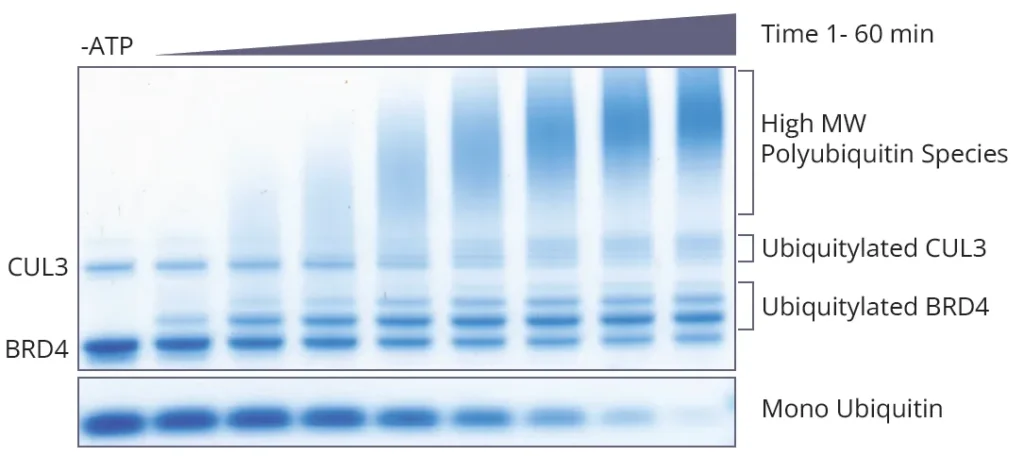
Native recognition and polyubiquitylation of BRD4 by CRL3–SPOP. Components: SPOP, (NEDD8)CUL3/RBX1, UBE2D1, UBA1, BRD4-BD1+BD2, and ubiquitin; 60 minutes at 37°C; Coomassie stain.
| Product | Product Code | Price | Details |
|---|---|---|---|
| CUL1 / RBX1, Neddylated | TE3-029 | From $350.00 | Show details |
| CUL3 / RBX1, Neddylated | TE3-034 | From $350.00 | Show details |
| CUL2 / RBX1, Neddylated | TE3-018 | From $525.00 | Show details |
| CUL4A / RBX1, Neddylated | TE3-014 | From $525.00 | Show details |
| Product | Product Code | Price | Details |
|---|---|---|---|
| UBA1 | TE1-001 | From $300.00 | Show details |
| UBE2D1 | TE2-002 | From $350.00 | Show details |
| CRBN / DDB1 | TE3-015 | From $350.00 | Show details |
| Ubiquitin, Untagged | TUB-037 | $150.00 | Show details |
| VHL / EloB / EloC | TE3-019 | From $350.00 | Show details |
| FBXO31 / SKP1 | TE3-091 | From $350.00 | Show details |
| SPOP | TE3-111 | From $350.00 | Show details |
Trilogie Bioscience’s neddylated Cullin/RBX1 complexes and companion reagents support the construction of CRL-focused biochemical workflows for investigating substrate recognition, ubiquitin transfer, and protein degradation mechanisms.
Need assistance choosing the appropriate CRL scaffold or assembling an in vitro ubiquitylation assay?
Investigate how different Cullin scaffolds, adaptors, substrate receptors, and RBX1 contribute to CRL architecture and ubiquitin-transfer reactions.
Reconstitute biochemical reactions using Cullin/RBX1 scaffolds with appropriate E1, E2, ubiquitin, and substrate-recognition components.
Study the relationship between CRL substrate recruitment and ubiquitin conjugation, as illustrated by the CRL3–SPOP/BRD4 reaction.
Explore the contribution of NEDD8-modified Cullin scaffolds to CRL activity and ubiquitin transfer.
Use CRL components to examine ubiquitin-proteasome pathway mechanisms relevant to targeted protein degradation research.
Develop mechanistic biochemical assays and screening workflows involving CRL pathway components.
Cullin-RING E3 ligases are multi-subunit ubiquitin ligase assemblies built around a Cullin scaffold and RING protein RBX1. Adaptor and substrate-receptor proteins help recruit targets for ubiquitylation.
Neddylation is the addition of NEDD8 to a Cullin. It promotes CRL activation and efficient ubiquitin transfer.
CUL1/RBX1, CUL2/RBX1, CUL3/RBX1, and CUL4A/RBX1 in neddylated formats.
Yes. Listed products include UBA1 (E1), various E2 enzymes, CRL-specific substrate-recognition components, ubiquitin, a BRD4 substrate set, and conjugation buffer. View products here, or contact a Trilogie scientist.
No. These products are for research use only and are not approved for diagnostic or therapeutic use.