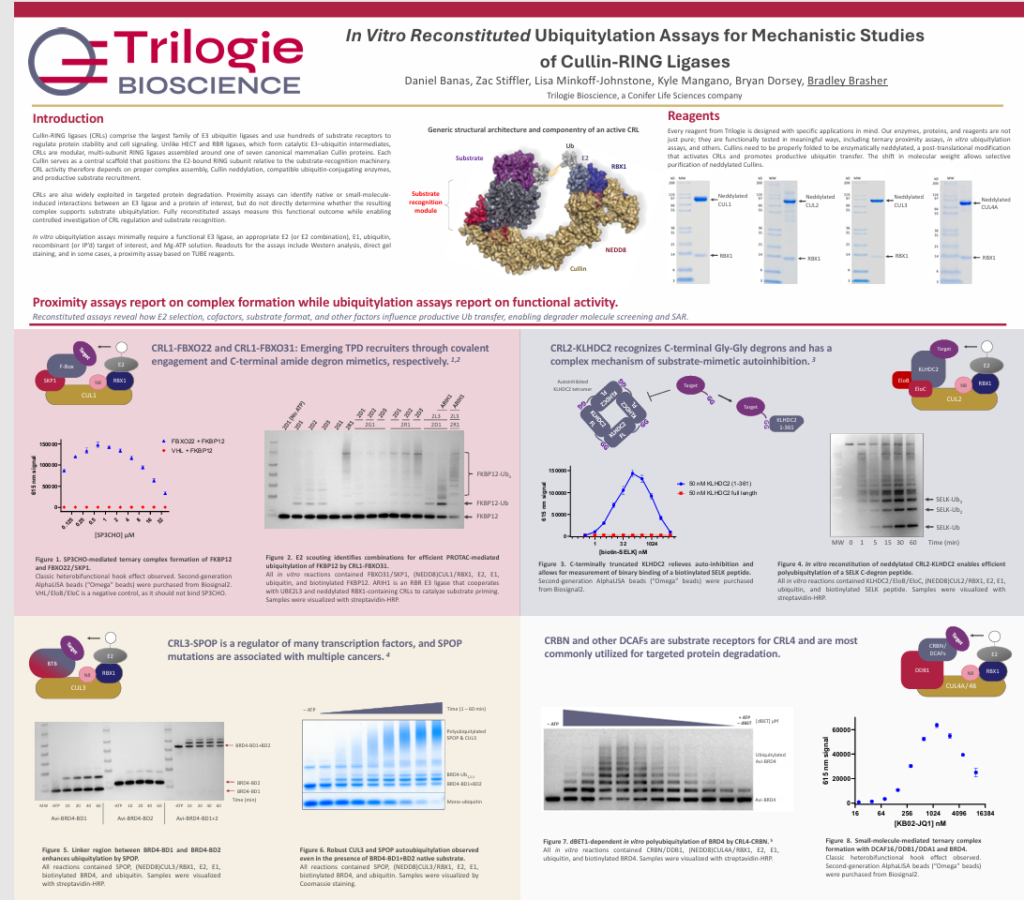
Cullin-RING ligases (CRLs) comprise the largest family of E3 ubiquitin ligases and use hundreds of substrate receptors to regulate protein stability and cell signaling. Unlike HECT and RBR ligases, which form catalytic E3–ubiquitin intermediates, CRLs are modular, multi-subunit RING ligases assembled around one of seven canonical mammalian Cullin proteins.
Each Cullin serves as a central scaffold that positions the E2-bound RING subunit relative to the substrate-recognition machinery. CRL activity therefore depends on proper complex assembly, Cullin neddylation, compatible ubiquitin-conjugating enzymes, and productive substrate recruitment.
CRLs are also widely exploited in targeted protein degradation. Proximity assays can identify native or small-molecule induced interactions between an E3 ligase and a protein of interest, but do not directly determine whether the resulting complex supports substrate ubiquitylation. Fully reconstituted assays measure this functional outcome while enabling controlled investigation of CRL regulation and substrate recognition.
In vitro ubiquitylation assays minimally require a functional E3 ligase, an appropriate E2 (or E2 combination), E1, ubiquitin, recombinant (or IP’d) target of interest, and Mg-ATP solution. Readouts for the assays include Western analysis, direct gel staining, and in some cases, a proximity assay based on TUBE reagents.
Connect with our scientific team to discuss your research needs, explore reagent options, or get guidance on your next experiment.