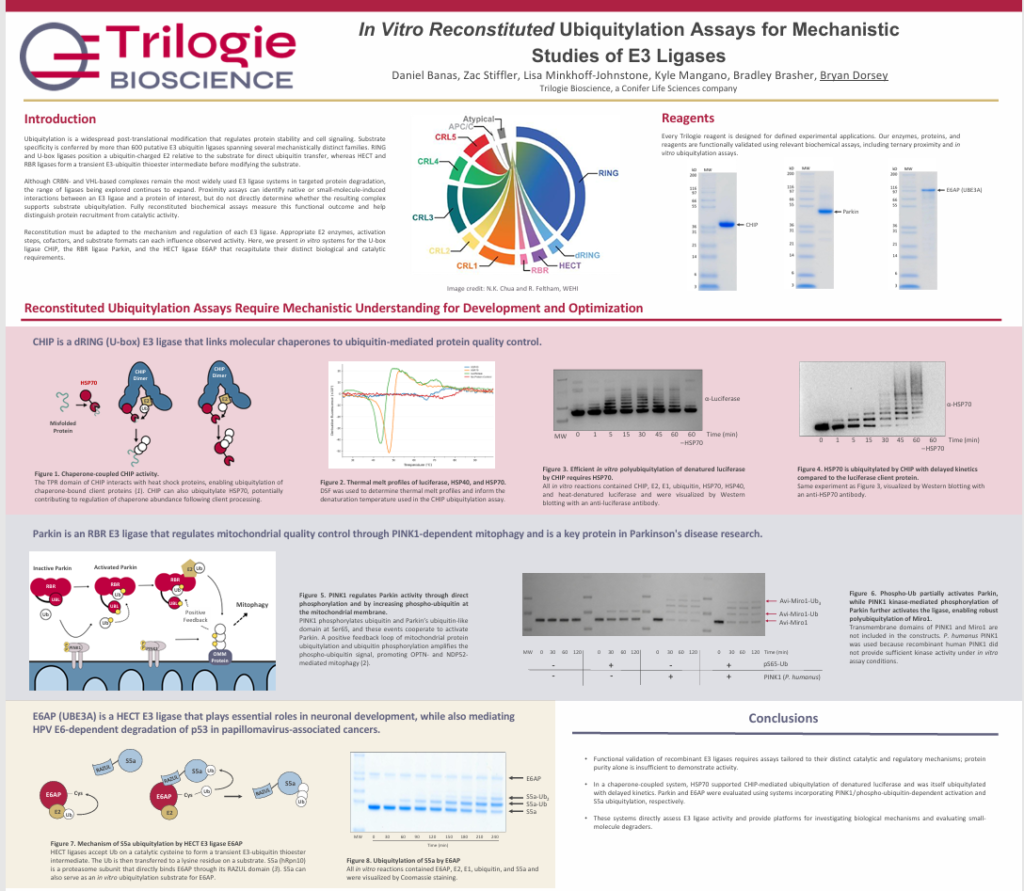
Ubiquitylation is a widespread post-translational modification that regulates protein stability and cell signaling. Substrate specificity is conferred by more than 600 putative E3 ubiquitin ligases spanning several mechanistically distinct families. RING and U-box ligases position a ubiquitin-charged E2 relative to the substrate for direct ubiquitin transfer, whereas HECT and RBR ligases form a transient E3-ubiquitin thioester intermediate before modifying the substrate.
Although CRBN- and VHL-based complexes remain the most widely used E3 ligase systems in targeted protein degradation, the range of ligases being explored continues to expand. Proximity assays can identify native or small-molecule-induced interactions between an E3 ligase and a protein of interest, but do not directly determine whether the resulting complex supports substrate ubiquitylation. Fully reconstituted biochemical assays measure this functional outcome and help distinguish protein recruitment from catalytic activity.
Reconstitution must be adapted to the mechanism and regulation of each E3 ligase. Appropriate E2 enzymes, activation steps, cofactors, and substrate formats can each influence observed activity. Here, we present in vitro systems for the U-box ligase CHIP, the RBR ligase Parkin, and the HECT ligase E6AP that recapitulate their distinct biological and catalytic requirements.
Conclusions
Connect with our scientific team to discuss your research needs, explore reagent options, or get guidance on your next experiment.