
Trilogie Bioscience’s F-box ligase reagents enable precise investigation of substrate recognition, ubiquitin-mediated degradation, and targeted protein degradation pathways. These purified, pre-assembled human protein complexes support biochemical assays, mechanistic studies, and drug discovery workflows focused on the ubiquitin proteasome system (UPS).
F-box proteins function as substrate recognition components within the SCF (SKP1–Cullin–F-box) E3 ligase complex, conferring specificity to protein degradation pathways that regulate cell cycle progression, signaling, stress responses, and protein homeostasis. Dysregulation of F-box ligases has been implicated in diseases including cancer and neurodegeneration, making them highly relevant targets for therapeutic research and targeted protein degradation strategies.
F-box proteins are critical substrate recognition components of the SCF (SKP1–Cullin–F-box) E3 ubiquitin ligase complex. By recruiting specific target proteins to the ubiquitylation machinery, F-box ligases determine substrate selectivity within the ubiquitin proteasome system and enable regulated protein degradation.
F-box ligases have emerged as important therapeutic targets due to their involvement in cancer biology, neurodegeneration, and dysregulated protein stability pathways. Their role in substrate recognition also makes them attractive tools for targeted protein degradation and molecular glue discovery efforts.
References:
Johmura Y, Harris AS, Ohta T, Nakanishi M. FBXO22, an epigenetic multiplayer coordinating senescence, hormone signaling, and metastasis. Cancer Sci. 2020 Aug;111(8):2718-2725. doi: 10.1111/cas.14534. PMID: 32536008.
Tan Y, Liu D, Gong J, Liu J, Huo J. The role of F-box only protein 31 in cancer. Oncol Lett. 2018 Apr;15(4):4047-4052. doi: 10.3892/ol.2018.7816. PMID: 29556284.
The SCF complex consists of CUL1, SKP1, RBX1, E2 ubiquitin-conjugating enzymes, and an F-box substrate recognition protein. This modular architecture enables highly selective ubiquitylation and degradation of target proteins through the ubiquitin proteasome system.
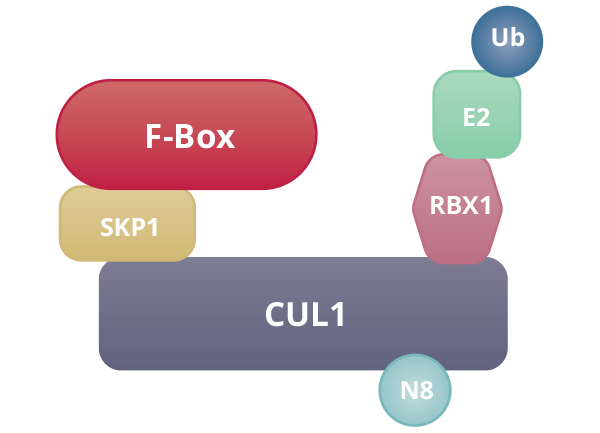
Schematic representation of the SCF (SKP1–Cullin–F-box) E3 ligase complex highlighting the substrate recognition role of F-box proteins within ubiquitin-mediated degradation pathways.
Trilogie’s F-box ligase reagents are designed to support reproducible biochemical assays and mechanistic studies by providing purified, pre-assembled, and functionally active protein complexes ready for immediate use in research workflows.
Trilogie offers functionally active FBXO22 / SKP1 and FBXO31 / SKP1 complexes to support studies of substrate recognition, ternary complex formation, induced proximity biology, and targeted protein degradation mechanisms.
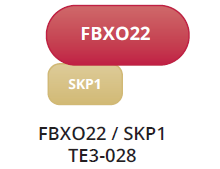
The FBXO22 / SKP1 complex supports research into substrate recruitment, degrader-mediated interactions, and ubiquitin-dependent signaling mechanisms.
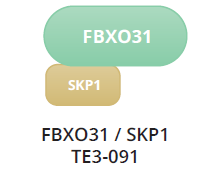
FBXO31 / SKP1 reagents enable mechanistic investigation of SCF-mediated degradation pathways and targeted protein turnover.
The ternary complex assay shown above demonstrates functional assembly and biological activity of the FBXO22 / SKP1 complex using the bivalent degrader SP3CHO and FKBP12. The observed hook effect curve supports proper folding and interaction capability of the recombinant complex, validating its utility for degrader discovery and mechanistic studies.
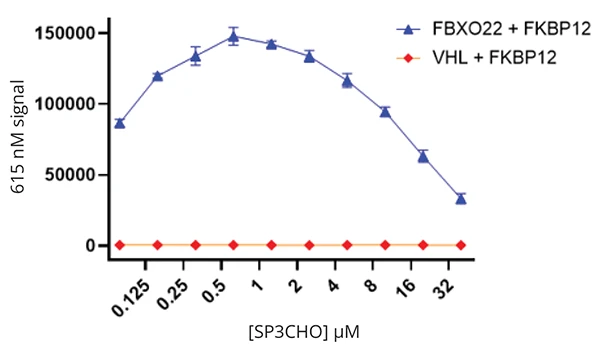
FBXO22 and FKBP12 ternary complex assay. A hook point curve was generated using SP3CHO, a bivalent degrader specific for FBXO22 and FKBP12. No binding was observed with FKBP12, SP3CHO and the negative control VHL ligase.
Kagiou, C. et al. (2024) Nat Commun 15, 5409
| Product | Product Code | Price | Details |
|---|---|---|---|
| FBXO22 / SKP1 | TE3-028 | From $350.00 | Show details |
| FBXO31 / SKP1 | TE3-091 | From $350.00 | Show details |
Need additional assay components or customized degradation workflow support?
Study substrate recruitment, ubiquitination, and induced protein degradation mechanisms using functionally active SCF ligase complexes.
Evaluate ternary complex formation and degrader-mediated protein interactions in molecular glue screening workflows.
Support biochemical characterization of targeted protein degradation systems and proximity-induced ubiquitination.
Investigate SCF E3 ligase assembly, substrate recognition, and ubiquitin proteasome system regulation.
Enable reproducible biochemical assays for discovery programs targeting ubiquitin-dependent degradation pathways.
F-box ligases are substrate recognition proteins within the SCF E3 ubiquitin ligase complex that direct specific proteins for ubiquitylation and degradation through the ubiquitin proteasome system.
SCF complexes are multi-protein E3 ubiquitin ligase assemblies composed of Cullin-1 (CUL1), SKP1, RBX1, and an F-box substrate recognition protein.
Yes. Trilogie’s F-box ligase products are purified, pre-assembled, and functionally active for biochemical and mechanistic assays.
Applications include targeted protein degradation research, molecular glue discovery, degrader screening, SCF mechanistic assays, and ubiquitin pathway studies.
No. These products are for research use only and are not approved for diagnostic or therapeutic use.