
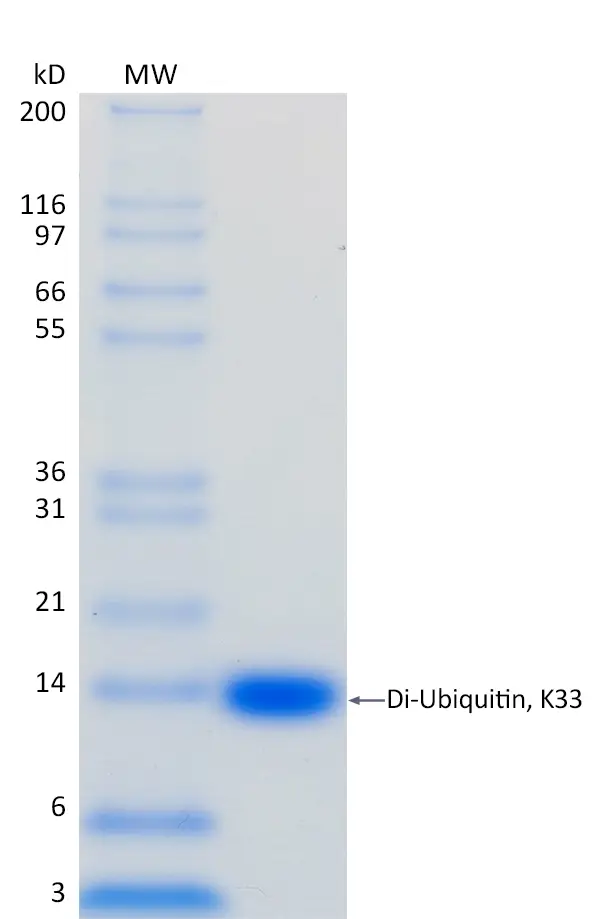
Recombinant Human K33-linked Di-Ubiquitin

Polyubiquitin Chains

Product Code: TUB-054
Verified Applications: Ubiquitin chains exhibit diversity in length, linkage type, and associated cellular functions. K33-linked Di-Ubiquitin serves as a valuable reagent in assays involving ubiquitin-binding proteins and as a substrate for ubiquitin-specific deubiquitylating enzymes (DUBs).
Activity: Polyubiquitin chains can serve as substrates in in vitro reactions with deubiquitylating enzymes (DUBs) that hydrolyze bonds between adjacent ubiquitin molecules. Furthermore, polyubiquitin chains can be utilized to explore the mechanisms of binding and recognition between these chains and other proteins with UIMs, UBAs, and or other ubiquitin-binding motifs.
Purity: 95 %
Concentration: 58 μM

For Research Use Only (RUO)

Add to Quote

Need special pricing?

Note: To maintain product quality, larger quantities may be packaged as multiple smaller aliquots. The 1 mg size is generally supplied in a single vial.

UniProt #: Ub
Predicted Molecular Weight: 17 kDa
Tag: Untagged

Background and Additional Info

Background: K33-linked ubiquitin chains are formed when the C-terminal glycine 76 of one ubiquitin is conjugated to lysine 33 of another, generating homotypic or branched polyubiquitin assemblies. They adopt a relatively compact conformation that supports selective recognition by ubiquitin-binding domains such as those found in trafficking and signaling adaptors. K33 linkages are assembled by E3 ligases including Cbl-b and members of the NEDD4 family in conjunction with specific E2 enzymes. Functionally, K33-linked ubiquitination regulates membrane protein trafficking, T cell receptor signaling, and kinase modification without directly targeting substrates for proteasomal degradation. Deubiquitylases such as TRABID exhibit activity toward K29 and K33 linkages, contributing to the control of signaling pathways and protein turnover.
Shipping: The product is shipped with dry ice. Upon receipt, store it immediately at the temperature recommended below.
Storage and Stability: Use a manual defrost freezer and avoid repeated freeze-thaw cycles. Aliquot and store ≤ -20°C (stable for 24 months from date of receipt).
References: Michel, M.A., et al. (2015) Mol Cell 58(1): 95-109 PMID 25752577

Tracz, M. & Bialek, W. (2021) Cell Mol Bio Lett 26(1) PMID 33402098

Yuan, W.-C., et al. (2014) Mol Cell 54(4): 586-600 PMID 24768539

Protein Sequence: MQIFVKTLTGKTITLEVEPSDTIENVKAKIQDKEGIPPDQQRLIFAGKQLEDGRTLSDYNIQKESTLHLVLRLRGG