
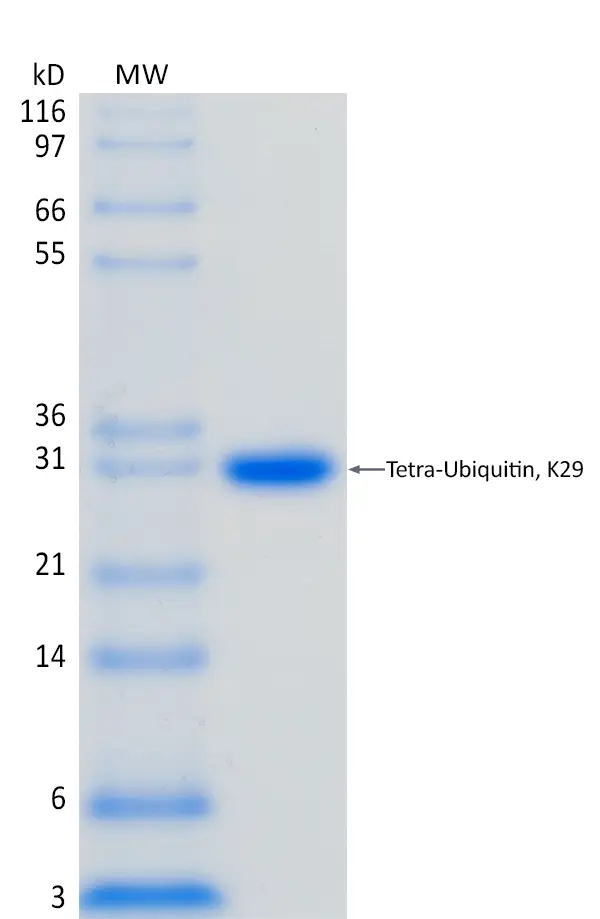
K29-linked Tetra-Ubiquitin

Product Code: TUB-053
Verified Applications: Ubiquitin chains exhibit diversity in length, linkage type, and associated cellular functions. K29-linked Tetra-Ubiquitin serves as a valuable reagent in assays involving ubiquitin-binding proteins and as a substrate for ubiquitin-specific deubiquitylating enzymes (DUBs).
Activity: Polyubiquitin chains can serve as substrates in in vitro reactions with deubiquitylating enzymes (DUBs) that hydrolyze bonds between adjacent ubiquitin molecules. Furthermore, polyubiquitin chains can be utilized to explore the mechanisms of binding and recognition between these chains and other proteins with UIM�s, UBA�s, and or other ubiquitin-binding motifs.
Purity: 95 %
Concentration: 29 μM

For Research Use Only (RUO)

Add to Quote
Predicted Molecular Weight: 34 kDa
Tag: Untagged

Background and Additional Info

Background: K29-linked ubiquitin chains are formed when the C-terminal glycine of one ubiquitin is conjugated to lysine 29 of another, generating homotypic or branched polyubiquitin architectures. They adopt an extended conformation that exposes hydrophobic patches, enabling selective recognition by ubiquitin-binding domains such as those in TRABID. K29 linkages are assembled by E3 ligases including TRIP12, UBE3C, and SMURF1 with specific E2 partners, and can also participate in mixed or branched chains with other linkage types. Functionally, K29-linked ubiquitination regulates proteotoxic stress responses, cell cycle progression, and chromatin-associated processes such as H3K9 methylation turnover. Deubiquitylases such as TRABID selectively recognize and cleave K29 linkages, shaping signaling outputs and maintaining protein homeostasis.
Shipping: The product is shipped with dry ice. Upon receipt, store it immediately at the temperature recommended below.
Storage and Stability: Frozen Dry Ice
References: Yu, Y., et al. (2021) Nat Chem Biol 17:896–905. PMID 34239127

Arroyo-Gomez, J., et al. (2025) EMBO J 44:6944–6978. PMID 41125851

Kristariyanto, Y.A., et al. (2015) Mol Cell 58(1):83-94. PMID 25752573

Protein Sequence: MQIFVKTLTGKTITLEVEPSDTIENVKAKIQDKEGIPPDQQRLIFAGKQLEDGRTLSDYNIQKESTLHLVLRLRGG